



Petrochemistry and oil refining
A New Growth Point
By July 1, 2025, Kazakhstan’s Ministry of National Economy, together with the Ministries of Energy, Industry, and Construction, will submit to the government specific proposals on tax and customs incentives for projects in the chemical and oil and gas chemical industries. Prime Minister Olzhas Bektenov issued this directive following a special meeting on industry development held in Astana in early May.
Incentives for the Industry
The Prime Minister also supported the initiative to develop a special Law “On the Oil and Gas Chemical Industry.” The relevant instruction was issued to the Ministries of Energy, Industry, National Economy, and Justice—to present a draft law by September 1 of the current year.
The new law will outline guarantees for providing oil and gas chemical projects with feedstock and necessary infrastructure, as well as state support measures and the development of further processing and related industrial sectors.
Thus, oil and gas chemistry is expected to become a new growth driver for Kazakhstan’s economy following crude oil production.
The Economic Impact of Petrochemicals
Petrochemicals are a high-tech industrial sector on par with computer hardware manufacturing, mechanical engineering, and pharmaceuticals. They possess a strong multiplier effect and have the potential to accelerate the transformation of national economies toward an innovation-driven development model. According to estimates by analysts from the Eurasian Development Bank, a $1 increase in output in this sector can generate a $2.62 increase in gross economic output overall.
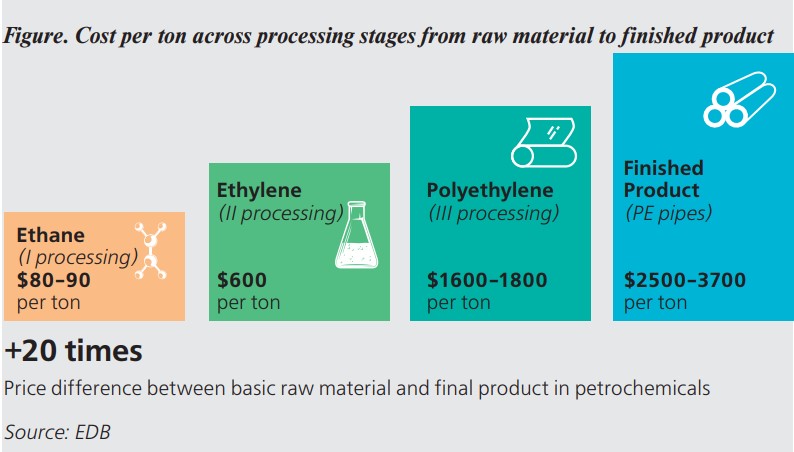
The sector is characterized by rapid growth in value added along the technological chain. Advancing production up the processing stages allows for a significant increase in the value created. The price gap between base feedstock and final polymer products can exceed twentyfold. The appeal of deeper hydrocarbon processing lies in its high profitability and resilience as a business model for extraction and refining companies.
Figure. Cost per ton across processing stages from raw material to finished product
Kazakhstan has all the necessary resources to develop the sector: first and foremost, raw materials (gas from the Tengiz and Kashagan fields, which is currently mostly reinjected into the reservoir), as well as government leverage to negotiate with project operators to ensure this gas is supplied at a low price. The country also has a labour pool freed up following the completion of major oil and gas infrastructure projects.
The government has approved a Roadmap for the Development of the Petrochemical Industry for 2024–2030. Its key targets include:
- increasing production volumes to 3 mln tons (in 2024, this figure amounted to just 540,000 tons against a target of 628,000 tons);
- implementation of 6 projects with a total investment of $15 bln and the creation of 20,000 permanent and temporary jobs;
- construction of infrastructure within the SEZ “National Industrial Petrochemical Technopark” in the Atyrau Region;
- stimulating domestic consumption of petrochemical products;
- strengthening the scientific base and human capital.
Kazakhstani Polypropylene
One of the first gas chemical projects implemented in Kazakhstan was the polypropylene plant of Kazakhstan Petrochemical Industries LLP, built using feedstock from the Tengiz field. The plant was launched in November 2022; however, the commissioning certificate has yet to be signed. KazMunayGas announced the completion of startup and commissioning in January 2025, but KPI and the EPC contractor continue working to eliminate technical issues that arise under increased equipment loads. A scheduled shutdown for planned maintenance is expected before the end of the year. Upon its completion, the commissioning certificate is expected to be signed. Still, according to KazMunayGas forecasts, the plant will produce only 486 thous. tons of polypropylene this year, thus falling short of the design capacity of 500 thous. tons per year (in 2024, the plant produced 249 thous. tons across 10 polypropylene grades).
Nevertheless, following the plant’s launch, Kazakhstan’s polypropylene exports increased ninefold, while polymer imports dropped from 63% to 17%. Thanks to low-cost Tengiz gas, prices for the polypropylene produced remain the lowest in Central Asia, giving it a competitive edge in exports—primarily to the Turkish and European markets.
To stimulate further downstream production, the “Forsazh” program was launched in 2024, enabling manufacturers of polymer-based products to purchase polypropylene at a discount, adjusted for each customer’s specific needs.
According to the company, eight Forsazh contracts have been signed with domestic manufacturers of carpet products, polymer corrugated packaging, consumables, and others. The discount ranges from 11% to 23%.
Overall, thanks to the marketing program, domestic consumption of polypropylene grew by 25% in the first quarter of 2025. The primary objective is to promote the creation and expansion of production of higher value-added polymer goods. The company also intends to expand exports, particularly westward, which, following the strategic plan, is expected to account for over 50% of the company’s total sales. Export deliveries of Kazakh polypropylene are handled by KPI LLP’s Russian shareholder, SIBUR, but increasing sales to Europe is being constrained by EU sanctions against Russian businesses.