


Petrochemistry and oil refining
Modernization of Kazakhstan❜s Refineries: Capacity Expansion or Construction of a New Plant?
Askar Ismailov, Independent ExpertKazakhstan is one of the world’s major oil producers (approximately 90 mln tons per year), yet ensuring a stable domestic supply of petroleum products is becoming an increasingly complex challenge. The country’s three operating oil refineries — Atyrau Refinery (ANPZ), Pavlodar Petrochemical Plant (PNHZ), and Shymkent Refinery (PKOP) — have nearly reached their design limits following the modernization program carried out between 2009 and 2018, and they no longer meet the growing demand. In 2024, total crude oil processing amounted to 17.9 mln tons, an increase of 1.1 percent compared to 2023. The output of petroleum products reached 14.5 mln tons, up 2.1 percent, including 5.46 mln tons of gasoline and 5.38 mln tons of diesel fuel. Despite these gains, the issue of supply shortage remains on the agenda.

Askar Ismailov
A seasoned oil and gas expert who participated in the development of Karachaganak, Tengiz, and Kashagan in Kazakhstan, as well as Shah Deniz (Azerbaijan), the South Caucasus Pipeline, and TANAP (Turkey). Author of the Telegram channel «PACE.» With over 20 years of experience, he worked at ConocoPhillips, Eni, and Lukoil. Recently, he managed chemical and petrochemical assets at the Samruk-Kazyna fund.
In addition to limited capacity, fuel supply to the domestic market is adversely affected by frequent unplanned refinery shutdowns. Between 2021 and 2023, the state-owned ANPZ and PNHZ experienced 106 unplanned shutdowns, while the partially privatized Shymkent Refinery recorded 21. Industry analysts and experts attribute this disparity to differences in management quality: state procurement and maintenance procedures are less responsive, resulting in delays in equipment repair and modernization. As a result, the country faces supply disruptions, especially during peak demand periods such as planting and harvesting seasons.
Consumption growth is outpacing production. In 2023 alone, domestic gasoline demand increased by approximately 4%, while diesel fuel demand rose by around 3%. The government acknowledges the urgent need for decisive measures to prevent future shortages and to strengthen national fuel security. Two primary options are under consideration: further modernization and expansion of existing refineries or construction of a new fourth plant. A discussion is underway regarding the sector's privatization to improve management efficiency.
Expansion of Existing Refineries: Projects and Performance Indicators
Following the completion of major modernization at the three refineries in 2018 (costing ~$6.3 bln, although planned initially at $3.5 bln), Kazakhstan nearly achieved self-sufficiency in gasoline and diesel. However, further consumption growth requires additional capacity. A specialized study by a Western analytical agency on market prospects through 2035 recommended that the Ministry of Energy of the Republic of Kazakhstan increase output by expanding existing plants rather than constructing a new one.
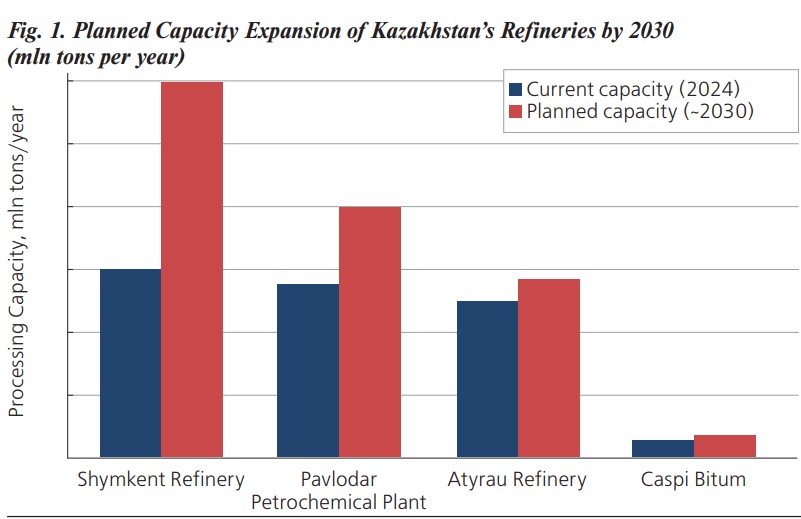
The Ministry supported this recommendation and announced the launch of projects to increase total refining from 18 to 27 mln tons/year by 2030. Specifically planned: increase PKOP from 6 to 12 mln tons/year, PNHZ from 5.5 to 8 mln tons/year, Caspi Bitum plant from 0.5 to 0.75 mln tons/year (already implemented), and ANPZ by 0.7 mln tons/year through secondary processing. Thus, the main increase is expected at Shymkent and Pavlodar.
Fig. 1. Planned Capacity Expansion of Kazakhstan’s Refineries by 2030 (mln tons per year)
Pavlodar Petrochemical Plant: Modernization and Expansion
The current development plan for the Pavlodar Petrochemical Plant (PNHZ) envisions a phased capacity expansion to 8 mln tons/year by 2030. The first phase is expected to increase processing volumes to approximately 6.5 mln tons, with the second phase raising it to 8 mln. The project is currently at the pre-feasibility study stage, so specific CAPEX figures and configuration parameters have not been disclosed. Preliminary estimates suggest an additional 2.5 mln tons may require USD 1.5–2 bln in investment. However, the use of existing infrastructure helps reduce unit capital costs. The expansion of PNHZ is expected to improve fuel supply to Kazakhstan's industrialized northern and eastern regions and decrease these regions’ dependence on petroleum product transfers from the central and southern parts of the country.
An increase in refining depth and a reduction in unit operating costs are anticipated due to the implementation of modern technologies. The available infrastructure (utilities, storage tanks, communications) will likely lower capital expenditures. However, there is one critical issue. That issue is dependence on a single crude oil source (the Russian Federation). This is a key risk. In the event of unfavorable market conditions or political factors, the Pavlodar Petrochemical Plant may face a shortage of crude or an increase in its price. Consequently, there is a logical question for KazMunayGas and the Ministry of Energy: how are the costs of safeguard mechanisms (for example, stockpiling or establishing backup supply routes) reflected in the economic calculations?
In practice, KazMunayGas does not evaluate risks as effectively as it claims. The problems at the KPI Inc. plant caused by the sale of a stake to Russia’s Sibur resulted in several European manufacturers' inability to service critical equipment under warranty. This occurred despite the fact that Sibur is not even under sanctions.
Shymkent Refinery (PKOP): Project to Double Capacity
The Shymkent Refinery is the youngest of the three major plants in Kazakhstan, with a design throughput of approximately 6 mln tons per year. Located in the south, it serves densely populated regions such as Almaty and Zhambyl Regions, the cities of Almaty and Shymkent, and the Zhetysu Region. The plant is owned by the joint venture PetroKazakhstan Oil Products (KMG – 49.7%, CNPC – 50.3%), contributing to its more efficient operation than the two quasi-state-owned refineries. After its 2017 modernization, Shymkent fully transitioned to Euro-5 fuel production. However, its current capacity no longer meets the growing demand of the southern regions. According to KMG, in 2024 PKOP processed around 5.74 mln tons of crude oil, nearing its maximum output.
In 2025, the Ministry of Energy and the plant’s shareholders approved a large-scale expansion to increase capacity to 12 mln tons annually, effectively doubling it. The project is valued at $5–6 bln, placing it on par with the cost of building a new refinery. In essence, a new processing complex will be constructed within the existing site. The project timeline follows: 2025–2026 – feasibility study (a pre-feasibility study has already been completed in partnership with the East China Engineering Institute); 2026–2028 – development of design and cost estimate documentation; 2028–2030 – construction and installation works.
Commissioning of the new facilities is scheduled for 2030. In June 2025, the parties (KMG, CNPC, and the Ministry of Energy) signed a framework agreement outlining the core principles for joint implementation, including long-term feedstock supply guarantees and investment preferences. While the final CAPEX will be confirmed after the feasibility study, it is already evident that this will be one of Kazakhstan's most capital-intensive refining projects.
However, the project’s payback is a matter of concern. With a CAPEX in the range of $6 bln, it must generate substantial cash flow to be viable.
A significant increase in crude supply will be required to raise throughput to 12 mln tons per year. Given the sharp decline in production in the Kyzylorda Region, feedstock availability is becoming increasingly critical. A diversified approach will likely be used to secure the additional 6 mln tons: CNPC may direct part of its output (for instance, from Aktobe Region fields) to cover its stake in the project, while KMG may raise domestic market quotas for Tengizchevroil and NCOC (Tengiz and Kashagan), or contract Russian crude under bilateral agreements.
The main risk associated with PKOP’s expansion lies in concentrating such a large capacity increase in a single location. The Shymkent Refinery will become the country’s largest, accounting for 12 out of 27 mln tons of total national capacity. Any unplanned outage could have critical consequences for Kazakhstan’s fuel supply system.
Atyrau Refinery: Growth Potential and Constraints

The Atyrau Refinery is the oldest in Kazakhstan. Commissioned in 1945, it is located in the western oil-producing region. Following modernization, its design capacity is approximately 5 mln tons per year. In 2024, the refinery processed around 4.9 mln tons, factoring in periodic downtime. The plant specializes in refining heavy, high-sulphur crude oil from Kazakhstan’s fields. In 2018, a Deep Oil Refining Complex (DORC) was commissioned here, costing approximately $2.1 bln. This allowed for increased yields of light products and the start of aromatic hydrocarbons (benzene, paraxylene) production. However, stable and incident-free operation has not been achieved: from 2021 to 2024, the Atyrau Refinery experienced frequent incidents, including failures of newly commissioned units.
The Ministry of Energy had previously indicated plans to develop a feasibility study (FS) for expanding the Atyrau Refinery, but a significant increase in primary refining capacity is not anticipated. The focus is addressing existing bottlenecks and increasing refining depth by approximately 0.7–1 mln tons. This would allow for processing the same volume of crude while increasing the yield of light-end products. The construction of new large-scale processing sections is unplanned due to space and infrastructure limitations within Atyrau. Given the age of the facility, the planned upgrade's top priority is operational reliability and safety. Before increasing throughput, the refinery must resolve persistent issues, including modernization of its power supply systems. At present, the facility suffers from regional power supply disruptions. Causes of equipment failures must be addressed, worn-out units replaced, and personnel skills upgraded.
One proposal from several experts merits separate analysis: rather than expanding capacity solely in Shymkent by 6 mln tons, it may be more rational to increase capacity in both Pavlodar and Atyrau by 3 mln tons each. This approach would promote a more balanced geographical distribution of refining capacity. Distributing expansion across two sites instead of one would reduce systemic risk. For instance, if a prolonged shutdown occurs in Shymkent due to an accident or construction delay, under the “6 mln tons only in Shymkent” scenario the country would lose all forecasted growth in fuel output. By contrast, under the “3 + 3” scenario split between Pavlodar and Atyrau, one site could still provide at least half of the planned increase in case of disruptions at the other. This type of diversification lowers the probability of a nationwide fuel shortage. Moreover, recent years have shown the vulnerability of both the Atyrau and Pavlodar plants to technical incidents.
KazMunayGas and the Ministry of Energy likely proceeded from the logic that the Shymkent project is already underway: the pre-FS is completed, cooperation with China is formalizing, and a 2030 launch target has been announced. A shift in strategy toward Pavlodar and Atyrau would require time for new research, negotiations, and potentially a new funding search. Yet the market does not wait: fuel demand is rising annually, and within two or three years, the country could face a widespread fuel shortage unless expansion plans are locked in.
Indeed, 2024 marked the first year Kazakhstan began importing even RON-92 gasoline. Without capacity increases, this dependence could grow. The Shymkent project is the most developed and closest to FS readiness. Cancelling or freezing it in favour of a “3 + 3” alternative may result in no scenario being executed on time. Politically and practically, this is a risk, so the authorities opted for Shymkent's “bird in the hand” rather than the “two in the bush” dual-site plan.
Additionally, doubling the capacity of PetroKazakhstan Oil Products (PKOP) represents a continuation of collaboration with a proven partner, CNPC, which already has experience with Shymkent’s previous modernization and maintains a vested interest (holding 50 percent ownership). This reduces the risk of underfinancing.
Alternative Scenario: Construction of a Fourth Refinery from Scratch
The idea of building a new, fourth refinery in Kazakhstan has been under discussion for over a decade, resurfacing most intensely during fuel shortages. As early as 2009, alongside plans to modernize the aging plants, a project was considered to construct a refinery at the junction with the oil pipeline to China in southeastern Kazakhstan, involving Chinese capital. At that time, modernization was preferred as the cheaper option: it was estimated at $3.5 bln versus $6 bln for a new plant. In the end, modernization was delayed and cost $6.3 bln, effectively matching the projected cost of a potential new refinery while failing to resolve the fuel supply issues fully.
As of today, the official position is as follows: a fourth refinery is planned for construction after 2030, with a projected capacity of up to 10 mln tons per year, located in western Kazakhstan. If the domestic market is saturated by expanding the existing three refineries to 27 mln tons, the new plant will be intended primarily for product export and advanced hydrocarbon processing into petrochemicals.
The core concept of the new project is to establish not just a refinery but a fully integrated oil and gas chemical complex. In other words, beyond producing motor fuels, the new facility would manufacture basic petrochemical products. This approach enhances added value and diversifies the product portfolio, which is important given the potential global decline in demand for gasoline and diesel after 2035. The likely location is in the western part of the country, near major fields and a maritime route (the Port of Aktau), through which petrochemicals can be exported. In the Atyrau region, work is already underway to establish a gas chemical cluster, and construction of the new refinery could serve as a synergistic addition.
The Economic Case for a New Refinery
The economic advantages of constructing a new refinery are clear:
- Crude Supply Security: Kazakhstan has surplus oil production. By reallocating part of the anticipated production growth, a new refinery with a capacity of 10 million tons would be able to receive feedstock without impacting export volumes.
- Reduced Dependence on Fuel Imports: A new plant would create a reserve in processing capacity, eliminating the risk of long-term shortages through 2040 and beyond.
- Export Potential of Refined Products: A fourth refinery could be geared toward foreign markets. The Central Asian fuel market is also experiencing deficits. Potential buyers include Uzbekistan, Tajikistan, and Afghanistan.
- New Technologies and Efficiency Gains: Starting from the ground up allows for integrating state-of-the-art processes with high energy efficiency, automation, and environmental performance. The specific operating expenditures (OPEX) and production costs at a new complex may be lower than those of older refineries, even after modernization. For instance, the depth of processing at the new facility could approach 100%.
- Regional Development: A plant in the western part of the country would have a multiplier effect. It would generate new jobs, stimulate infrastructure development (in energy and transportation), and bring contracts to the construction and service sectors. Capital investments of $8–10 bln would boost GDP and could attract foreign direct investment, provided that strategic partners are involved.
Evidently, without long-term investment in refining, the fuel supply issue in Kazakhstan will remain unresolved. Despite the billions invested in modernization, the problem has not been fully addressed. This raises a deeper question: perhaps the issue lies within the current system of state asset management? At this point, the topic of refinery privatization enters the spotlight.
Debate on Refinery Privatization: Models, Risks, and Market Impact

In spring 2025, the Agency for Protection and Development of Competition (APDC) unexpectedly proposed privatizing 50% stakes in two major refineries: the Atyrau and Pavlodar plants. APDC First Deputy Chairman Rustam Akhmetov cited the positive experience of the Shymkent Refinery, where 51% of shares are held by a private investor (CNPC): “There are fewer incidents and lower repair costs at the Shymkent Refinery—private management is more efficient than state governance,” he noted. The proposal sparked widespread debate.
The option proposed by APDC involves selling approximately 50% of shares in ANPZ and PNHZ to strategic investors. The state, through KMG, would retain a significant stake while transferring operational management to the private sector. This model is similar to the Shymkent joint venture, where the stakes are roughly equal. The advantage lies in the investor’s motivation to manage efficiently while the state retains a controlling stake (50%+).
The drawback is that a minority co-owner may lack interest in investing if they do not have decision-making authority. In addition, the risks of political interference remain.
A more radical scenario would involve selling more than 51% of shares in one or both refineries to a major player (either foreign or a consortium). In this case, the investor gains autonomy to optimize staffing, investment planning, and pricing policies. This would mean relinquishing direct influence over strategic assets, a politically sensitive issue for the state. This is evident in Kazakhstan’s breaches of OPEC+ oil production agreements.
If refinery shares are sold to an effective investor and the market is simultaneously liberalized, consumers would benefit in the long run. Motivated by profit, a private owner would strive to produce more high-quality products to sell at higher prices domestically (after price controls are lifted) and to export surpluses. This would stimulate refinery competition, replacing the current KMG monopoly with multiple players. For example, Shymkent (CNPC) already competes with PNHZ/ANPZ (KMG), with indirect indicators showing Shymkent’s lower operating costs and shorter repair periods.
If, hypothetically, Pavlodar is managed by Lukoil and Atyrau by Tatneft, three independent companies would compete for market share. While Kazakhstan has only three major refineries, which limits full-fledged price competition, this setup would eliminate KMG’s vertical monopoly. Theoretically, it would increase responsiveness to customer needs: expanding fuel assortments (blends, premium grades), developing retail networks, and improving service.
The retail fuel market is already relatively competitive (with Qazaq Oil, Sinooil, Gazpromneft, Helios, and other fuel station networks). If competition extends to production, market mechanisms would function more effectively. Seasonal fluctuations would be smoothed out as private players prepare for demand peaks by importing or stockpiling inventory to retain market share.
On the other hand, negative consequences cannot be ruled out. Privatization without adequate liberalization may worsen the situation in the short term. New owners, who cannot earn under price caps, may reduce output to pressure the government. Or they may cut corners on safety, leading to accidents and shutdowns (as seen in the 1990s with privatized refineries in post-Soviet countries).

It is worth recalling that the state funded the modernization of Kazakhstan’s refineries. A private entity might have been unwilling to incur such expenses, and the plants would still operate with outdated equipment. Thus, state management had its advantages: it enabled socially significant investment projects and maintained low prices for the public. Privatization will inevitably lead to higher fuel prices—otherwise, investors will not be able to operate profitably. However, prices are rising anyway for objective reasons, making it difficult to determine whether privatization or market integration is the primary driver.
Ultimately, an objective assessment of the debate suggests that privatization without a reform of market principles will not achieve its intended goal. Conditions for competition must be developed simultaneously: correcting price distortions, providing subsidies to vulnerable population groups directly rather than through fuel price controls, and ensuring independent oil suppliers have access to refineries. Only then will strategic investors be able to enter and transform Kazakhstan’s refineries into efficient enterprises integrated into global supply chains.
President Kassym-Jomart Tokayev previously criticized the inefficiency of multibillion-dollar refinery modernization efforts, effectively signalling the need for new approaches. A compromise solution could be gradual privatization: first, selling minority stakes while maintaining KMG control, establishing transparency and accountability, and later, if successful, increasing the private stake to a controlling share. At the same time, administrative barriers in the fuel market must be removed ahead of schedule. Without liberalization, privatization will amount to a change in signage, not substance.
In Lieu of a Conclusion
Kazakhstan has reached the point where previous methods (100% state control under fixed pricing) have exhausted their potential. Further industry growth is possible only through economically viable projects. This means prioritizing investments with the highest return, whether expanding existing refineries or building a new plant.
Decisions must be grounded in a precise analysis of CAPEX/OPEX, logistical costs, and market outlook. The right combination of modernization and greenfield development, amplified by effective management, potentially with elements of privatization, can enable Kazakhstan to not only meet its domestic demand for petroleum products but also emerge as a notable exporter of high-quality fuels and petrochemicals.
This will require full utilization of resources, including gas production from major fields. In particular, feedstock from the Karachaganak field could produce ETBE, ethanol, and alkylates, key components of high-octane, environmentally compliant gasoline. This is a critical and necessary step.
This strategic objective will demand coordinated action from the government, national companies, and private investors in the years ahead.