



Expertise
Natural Gas Prices in Kazakhstan to Increase July 1. And will continue to grow by an average of 33% annually over the next three years
The May order issued by the Minister of Energy, titled “On Amendments to the Order of the Minister of Energy of the Republic of Kazakhstan dated June 6, 2023, No. 210 ‘On Approval of the Ceiling Prices for Wholesale Sales of Commercial Gas on the Domestic Market of the Republic of Kazakhstan’s’” provides for a phased adjustment of ceiling wholesale gas prices over three years, with an average annual increase of up to 33%.


The three-year period will allow all categories of consumers to adapt to the new conditions gradually, and the industry will reach a level that ensures its stable operation and financing of necessary investment programs.
The gas market pricing reform pursues several strategically important goals for the country:
- Guarantee physical availability of gas: ensure sufficient resources for the population and industry, eliminating the risk of shortages.
- Increase supply reliability: attract necessary funds for the construction, modernization, repair, and development of gas transportation infrastructure throughout the country.
- Strengthen energy independence: create economic conditions for the development of new fields and increased gas production.
- Balance pricing: gradually smooth out existing regional disparities in wholesale prices, making the system more equitable.
From left to right: Nursultan Yeshmukhan, Marat Shibutov, Askar Ismailov, Rasul Rysambetov, Oleg Chervinskiy

It is important to emphasize: the order concerns exclusively wholesale prices. Final retail tariffs for the population will be formed separately and approved by authorized bodies, taking into account all cost components. Prices will be set separately for each region, based on objective regional costs for purchasing, transporting, and storing commercial gas.
Why gas is becoming an increasingly significant element of the economy in today’s world:
- Gas is a predictable and environmentally cleaner energy source. Its use represents a transitional stage from the so-called “carbon” economy to a “green” one;
- Gas power plants respond more quickly to consumption peaks;
- In addition to being a fuel for energy production, gas is a valuable raw material for the gas chemical industry. For Kazakhstan, this is especially important in the context of building a diversified economy. The Republic is beginning the implementation of several large investment gas chemical projects that will require raw materials.
Today, Kazakhstan is among the countries with the world’s highest gas consumption per capita. Over the past decade, from 2013 to 2023, consumption has increased tenfold.

The country needs more and more gas due to the increasing number of consumers and active regional gasification, the conversion of “dirty” coal and fuel oil thermal power plants to cleaner gas (for example, in Almaty), and the connection of large industrial consumers to gas networks (for example, the Qarmet plant in Temirtau). According to QazaqGaz Aimaq, during the past heating season, daily gas consumption in the country increased by 5% compared to the previous one. According to the company’s forecasts, in just two and a half years, by 2028, gas consumption will increase by half: from the current 21.2 bln to 32.4 bln cubic meters.
To meet these increased needs, investments are required. In exploration and development of new gas fields, construction of transport highways, and gas processing plants. The comprehensive development strategy of the national company QazaqGaz consists of 12 areas of development. In particular, construction work on the second line of the main gas pipeline “Beineu-Bozoy-Shymkent,” which is critically important for gas supply to the southern and central regions, will begin soon. Also, without a new pipeline, gasification of the north and northeast of the country is impossible unless it is done by laying a gas pipeline from Russia and purchasing Russian gas.
QazaqGaz Comprehensive Strategy Consists of 12 Development Directions
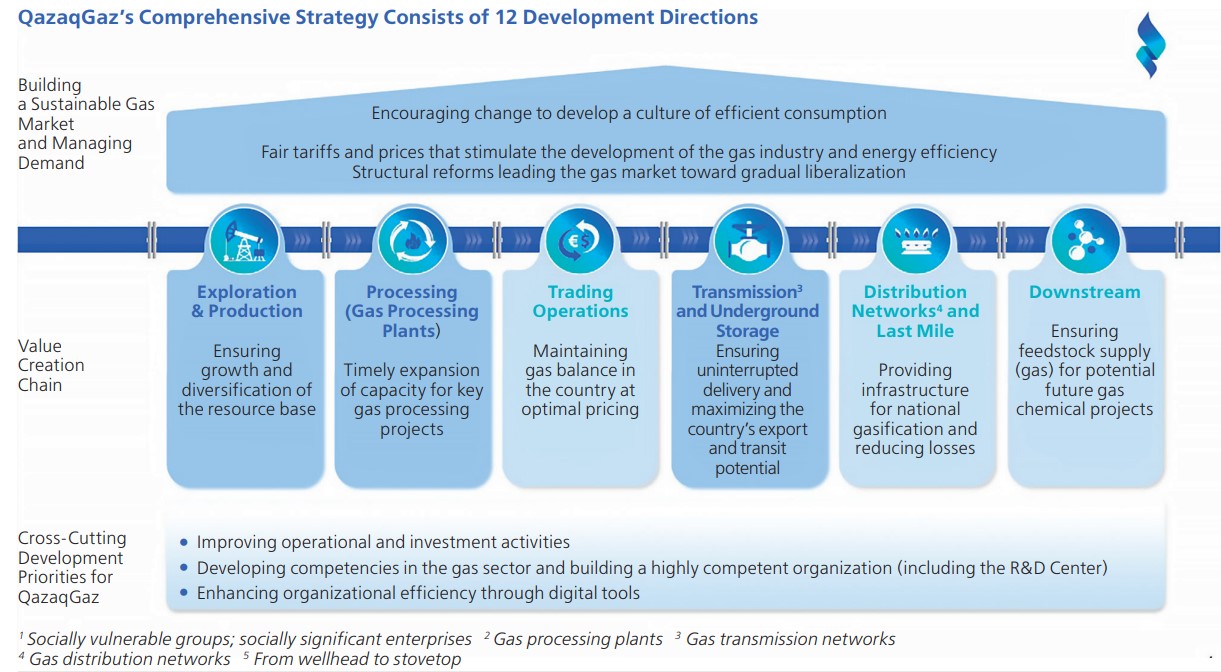
The first gas processing plant is under construction, and another is planned near the Kashagan field on the Caspian Sea, as well as a plant at Karachaganak. After their launch, the country's shortage of commercial gas should become a thing of the past.
The main question is: Where will the money come from to finance all these projects if the current state-set maximum wholesale prices for commercial gas are below the cost of its production and transportation?
During the round table “Reform of Natural Gas Pricing: Reasons. Consequences. Communication with Consumers,” organized in Almaty by Petroleum magazine (with “QazaqGaz” as the general partner of the event), Nursultan Yeshmukhan, the director of the pricing policy and monitoring department of the national company “QazaqGaz,” provided characteristic figures.
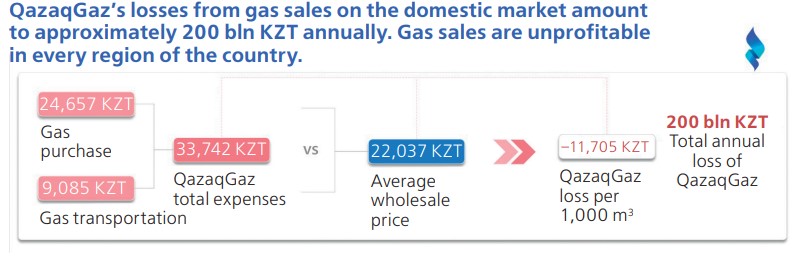
Today, the national company purchases gas from subsoil users at an average of 24,657 tenge per thousand cubic meters; transportation to gas distribution companies costs an additional average of 9,085 tenge. Thus, the national company's gas cost is 33,742 tenge. And the state-set average maximum wholesale price is 22,037 tenge. The result is more than 11,000 tenge of loss per thousand cubic meters. By the end of the year, this results in 200 bln tenge in losses for the national company. If nothing changes, in two years, these losses, considering consumption growth, could reach 1 trln tenge.
Money does not appear out of nowhere—profits from the export of Kazakh gas to China cover the loss. However, with growing domestic consumption, less and less volume remains for export each year, and profits are made to subsidize domestic consumers. “The company’s annual losses have increased by 80% after price reductions since 2019 amid active consumption growth. This situation hinders the gas industry's development,” said Mr. Yeshmukhan. Market liberalization and the abandonment of artificially restrained tariffs are an urgent necessity in the logic of the national company’s development.
QazaqGaz losses from gas sales
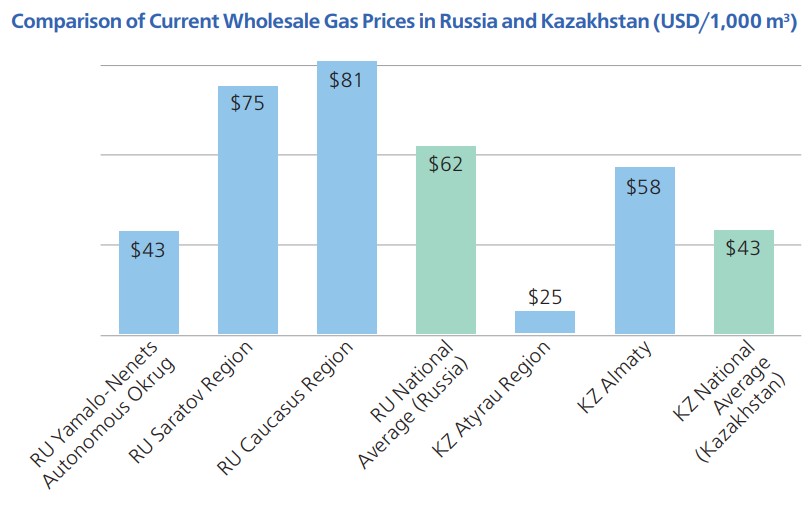
Comparison of Current Wholesale Gas Prices in Russia and Kazakhstan
The director of the National Analytical Center “Nazarbayev University,” Rasul Rysambetov, drew the attention of roundtable participants to flaws in the subsidy system: “The entire energy sector needs a major overhaul and a review of basic things and compensations. Currently, subsidies are like carpet bombing—subsidies are received even by those who objectively do not need them. And with the development of digitalization, subsidies can be made targeted.”
To correct these imbalances, QazaqGaz Aimaq JSC and the Ministry of Energy developed and implemented a pilot project “Digital Wallet” in two regions (Shymkent and West Kazakhstan region). The service is provided to citizens of the Republic of Kazakhstan with a registered status of targeted social and housing assistance through the electronic government service “eGov Mobile.”
The system works simply: it is integrated with the eGov database and independently identifies citizens entitled to benefits. They automatically receive SMS notifications about an available discount of up to 24%. According to the company, the pilot digital project “Social Wallet” demonstrated high efficiency in two regions and received positive consumer feedback. A decision was made to scale the project nationwide this year. It will improve the efficiency of the digital social support system and provide targeted assistance to those who genuinely need it. As of May 1, 2025, 7,027 residents of Shymkent and 2,819 residents of the West Kazakhstan region have already used digital discounts.

Returning to the roundtable—Aiaal Eginov, who has worked in senior positions at Sakhaneftegaz (RF) for more than 15 years, shared his vision of what can be used from the Russian experience in reforming under Kazakh conditions. Why can Kazakhstan no longer wait?—he asks. And he provides arguments.
- Historically low domestic gas prices in Kazakhstan (3–5 times lower than export prices) have led to chronic unprofitability of QazaqGaz: losses of up to 1 trln tenge by 2026.
- Declining export revenues eliminate the possibility of cross-subsidizing the domestic market—as previously happened in Russia, where export revenues covered domestic costs. In the face of falling exports, Kazakhstan and Russia must look for a sustainable regulatory model.
- Infrastructure wear and processing deficit. Only 50% of raw gas is processed, which restrains oil production growth (especially at Kashagan and Karachaganak), hindering GDP growth.
- Accelerated gasification without resources. In Kazakhstan, the gasification level reached 62.4% by the end of 2024, but gas processing plant capacities and networks lag behind demand, forming an internal deficit.
- International obligations. The introduction of the EAEU Single Gas Market has been postponed to 2027 but requires synchronization of tariffs and market models.
- Lessons from Russia: delayed reforms lead to turbulence. A high degree of monopolization, outdated regulatory framework (since 2006), lack of full deregulation, and a weak exchange model have led to the internal market in the Russian Federation becoming “secondary” and unprofitable. Kazakhstan must take these mistakes into account.
Conclusion: Kazakhstan needs its own sustainable and investment-attractive gas market model. Without timely reform, it risks repeating Russia’s path with decades of postponed decisions and losing competitiveness.
“Delaying gas pricing reform is more costly than expensive gas. It means chronic losses, inability to update infrastructure, and overall industry development slowdown,” the expert concluded.
Independent experts participating in the discussion shared the same opinion: political scientist Marat Shibutov, specialist in strategic studies and applied ecology, and practitioner with 25 years of experience, Askar Ismailov, founder and head of the analytical company PACE Analytics.
Speakers emphasized that the issue of gas pricing in Kazakhstan is one of the most complex and, in many ways, even defining not only for the gas industry itself but also for the entire national economy. Such a significant role is due to the high share of gas in the country’s energy balance and the impact of gas prices on social stability and the economy's competitiveness. Precisely because of the seriousness of potential macroeconomic consequences, any decisions regarding gas prices have been and are being made with difficulty. Unlike the prices of other energy resources, they remained regulated for a long time, despite the presence of some market mechanisms for price formation.
In general, no one doubts the ultimate success of gas pricing reforms in Kazakhstan, as their ideology includes a new purchase price formula, fiscal benefits for subsoil users, and prospects for price harmonization within the EAEU. These reforms will attract investments in new gas production and processing projects and create and harmoniously develop a competitive gas industry in the country.