


KIOGE-2026
ILF❜s international experience brings industry best practices to Kazakhstani projects
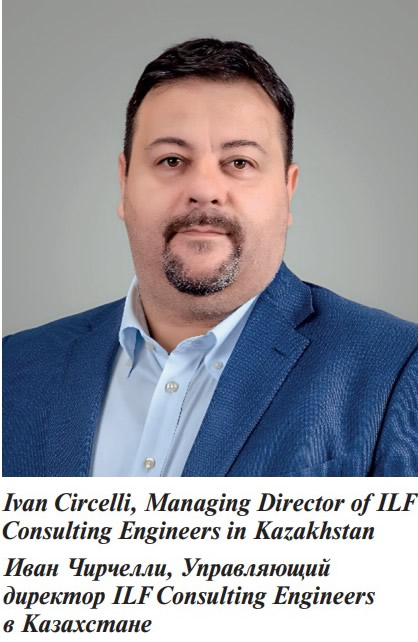
Exclusive Interview with Ivan Circelli, Managing Director of ILF Consulting Engineers in Kazakhstan, for Petroleum Magazine
– Over the past years, Kazakhstan’s oil and gas industry has undergone significant transformation. In your view, how has the role of international engineering and consulting companies evolved in the development of major energy projects in the country?
– Few years ago, many international engineering houses arrived as exporters of standards and specialist know‑how, typically parachuted into discrete FEED scopes. Today, their mandate is decidedly broader: they are capability partners and system integrators, embedded early in concept framing, helping to engineer permitting pathways, compress schedules, and develop local supply chains that endure beyond a single project. That shift has been accelerated by three realities on the ground. First, the center of gravity has moved from megaproject Greenfields to complex brownfield expansions and debottlenecking around live, high‑H2S assets, work that demands elite interface management and an HSSE culture that travels well. Second, local content expectations have sharpened, pushing global firms to invest in permanent Kazakh teams, structured knowledge transfer, and bilingual/ bicultural delivery models. Third, the decarbonization agenda is now operational, from methane abatement to electrified compression and digital integrity, requiring multidisciplinary, system-wide solutions rather than siloed designs.
You can see this evolution in today’s gas‑system buildout. The next phase of the Beineu-BozoiShymkent (BBS‑2) program, around 1,600 km of new pipeline plus six compressor stations, has brought together QazaqGaz, Qatari investors, and international engineers to deliver FEED, detailed design, and execution strategies at national scale. This is not «outsourcing»; it’s co‑engineering Kazakhstan’s backbone with long‑term operating flexibility in mind and increasing the In-Country value.

– With more than twenty years of experience in the oil and gas industry and work across several countries, what key differences do you observe in project management practices between Kazakhstan and other regions where you have worked?
– Approvals in Kazakhstan, environmental, industrial safety, and ecological, are rigorous and must be treated as a first‑order schedule driver. The projects that finish well integrate permitting into design, with bilingual compliance teams and a change‑governance regimen that anticipates regulator feedback.
Short weather windows, long logistics chains, and harsh winter conditions make modularization and off‑site readiness more than buzzwords. Here, winter work is a strategic variable, not a contingency.
Tengiz, Karachaganak, and Kashagan are case studies in interface management. Tengiz’s FGP/ WPMP sequence, for instance, demanded choreography across pressure regimes and new power/ compression trains while safeguarding base business. As TCO put it on WPMP start‑up: «A major step in advancing our Future Growth Project to its safe completion.»
Relative to markets dominated by pure lump‑sum EPC, Kazakhstan rewards hybrid structures, EPCM with shared KPIs, alliances, and early contractor involvement, especially where local content and technology transfer are integral to success. The Karachaganak expansion (KEP‑1A), progressing through staged compression and dehydration upgrades, is illustrative: local content in goods reportedly around 62% in that tranche.
Ministry policy, national companies, regional Akimats, and communities all sit close to the workface, more so lately as the government doubles down on gasification and methane action plans. That makes transparent engagement and data‑rich reporting as critical as Primavera.
– ILF Consulting Engineers is involved in complex infrastructure and energy projects. What engineering and technological solutions are currently becoming the most important for gas transportation systems and energy infrastructure development?
– Operators are shifting from periodic checks to always‑on integrity, blending high‑resolution in‑line inspection with fiber‑optic DAS/ DTS along corridors and aerial/satellite analytics to detect third‑party interference, small leaks, or geohazards before they scale. That maps directly onto Kazakhstan’s methane agenda post‑Global Methane Pledge, where national planning now emphasizes satellite detection and rapid‑response regulation.
As systems swing between domestic supply and export duty, high‑efficiency electric or hybrid drivers with VSDs and smarter surge control widen the operability envelope, crucial for a network expected to lift national gas supply toward 74 bcm by 2029-2030, with domestic demand potentially doubling by 2030, according to QazaqGaz leadership.
Hydrogen readiness and decarbonization enablers are also moving mainstream. Material compatibility, fracture control, metering, and sealing for H2 blends are becoming standard study items for newbuilds, while CCS‑ready designs and waste‑heat recovery are prudent hedges for mid‑stream and gas‑to‑power. These priorities are aligned with Kazakhstan’s 2060 carbon‑neutral strategy and near‑term methane commitments.
On the digital side, the sector is adopting operational twins that fuse SCADA, historian data, and predictive maintenance. The value, however, only materializes when twinned with IEC 62443‑aligned segmentation and secure remote access, non‑negotiables as critical gas infrastructure expands.
These priorities are materializing in flagship programs such as the BBS‑2 expansion (≈1,600 km and six compressor stations) and associated gas‑processing investments under the Kazakhstan-Qatar program, where FEED/detailed design are scoped to deliver capacity uplift and flexibility while lowering the emissions intensity of supply.
In parallel, the growing relevance of gas‑chemistry projects in Kazakhstan elevates the premium on methodological discipline and interface coordination. These projects demand alignment with international engineering and environmental standards and meticulous integration of process units with offsite and utility systems from day one. ILF’s experience on comparable large‑scale programs allows us to apply a well‑established technical framework, stage‑gated process evaluation, rigorous interface and tie‑in planning, structured risk assessment, and robust environmental compliance methodologies, so that decisions taken in Kazakhstan are anchored in sound, internationally aligned engineering practice and deliver safe, operable plants with credible schedules.

– Modern energy projects often involve multicultural and multidisciplinary teams. Based on your experience, what management approaches are most effective in leading such teams and delivering large-scale projects successfully?
– When scope, local content, emissions performance, and operability are all explicit success criteria, trade‑offs become faster and fairer. Tengiz’s expansion is a case in point: leadership repeatedly emphasized safe completion and base‑business continuity as the non‑negotiables as WPMP came online and FGP advanced.
Weekly «expedite the edges» sessions, clear interface owners, and a living register are mission‑critical in brownfields like Karachaganak, where re‑injection compression and dehydration upgrades have to dovetail with existing operations to hold the liquids plateau.
Contract clarity with change agility. In Kazakhstan’s context, multilingual, multi‑operator, and regulator‑intense, plain‑language scopes (often bilingual), transparent change workflows, and leading indicators (RFI cycle time, interface closure, design maturity) prevent disputes that would otherwise derail winter‑sensitive schedules. The state’s stepped‑up push on gasification and transit only heightens the premium on predictability.
Build psychological safety across cultures. Inclusive meeting norms (English/Russian/Kazakh), written recaps, and visible rewards for early risk flagging are not soft skills, they are schedule control mechanisms. Kazakhstan’s top operators and national companies now expect this level of rigor as part of «no‑surprises» delivery.
«The expansion of the pipeline system will improve the country’s energy security and will allow replacing coal-fired power plants with gas-fired plants.»
ILF Consulting Engineers group statement on the BBS program
«Uninterrupted gas supply to the residents of Kazakhstan always remains a priority for us… we prepare for winter starting in March.»
CEO of QazaqGaz is Alibek Zhumabekovich Zhamauov
«We need constructive dialogue between operators and business… localization and expanding the participation of Kazakhstani companies in large projects.»
Rashid Zhaxylykov, Chairman of the KazService Presidium
– Industry associations are often seen as important platforms for dialogue and collaboration. In your opinion, what role do they play in fostering cooperation between opera tors, service providers, and engineering companies in Kazakhstan’s energy sector?
– Industry associations act as the sector’s connective tissue. They collate operator demand signals, surface supply‑chain constraints, and translate both into policy suggestions and procurement hygiene that benefit project outcomes. The conferences have matured into a true dialogue platform, drawing ministers, national companies, and all three mega‑operators (TCO, NCOC, KPO) into practical conversations about localization, procurement reform, and pipeline project pipelines.
Beyond convening, associations shape the capability agenda. From the TOP‑75 influence mapping to AI forums and supplier‑qualification clinics, Industry associations help to move the conversation from local‑content compliance toward competitive local capability. In a year when Kazakhstan is pushing through the BBS‑2 expansion and ambitious gasification milestones, that role, setting expectations on safety, quality, and schedule realism, has never been more consequential.